If you haven’t read Part 1 of our trip to the Peruvian Amazon, you can read it here.
Day 4 – Exploring Deep In The Jungle
Cocha Salvador
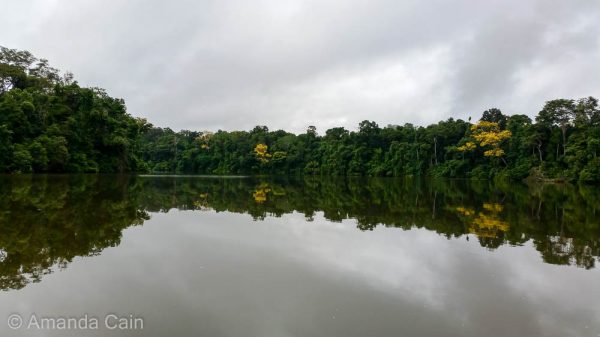
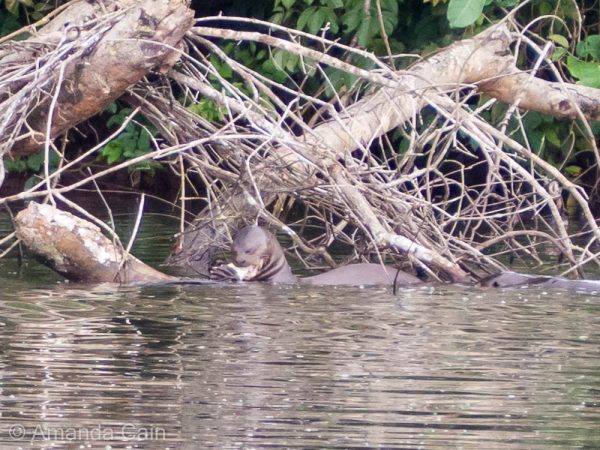
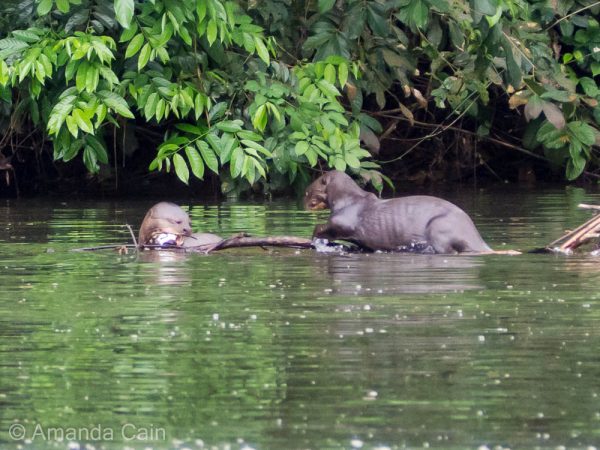
Because the rivers in the Amazon Rainforest change course regularly, they can leave behind big oxbow lakes like Cocha Salvador. So you get animals that prefer the still lakes to the rushing river, like giant otters. They can grow as big as a person and there was a whole family living here. We had a small “catamaran” to take us around the lake. When I say “catamaran”, I mean two canoes joined together with a platform, and two guys in the front paddling away. But it worked well since there were no currents to worry about. And it was quiet so we wouldn’t scare the animals away. Our guide Juanjo told us that busier jungle lodges used boats with outboard motors to chase any animals they saw. Which of course isn’t very good for the animals. So we were glad we had our little “catamaran”.
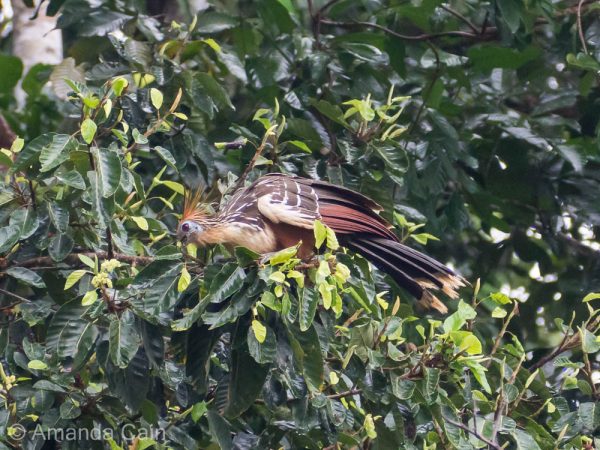
We saw plenty of birds as we paddled along the lake, including some crazy looking ones like the hoatzin in the picture above. And groups of cormorants and terns fighting over fish. But no giant otters. It was also raining as well which meant that the giant RIVER otters didn’t want to get wet…
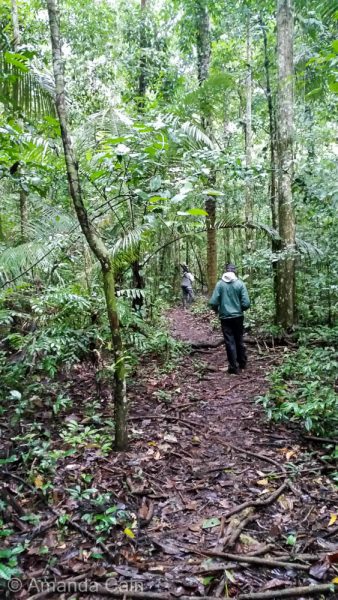
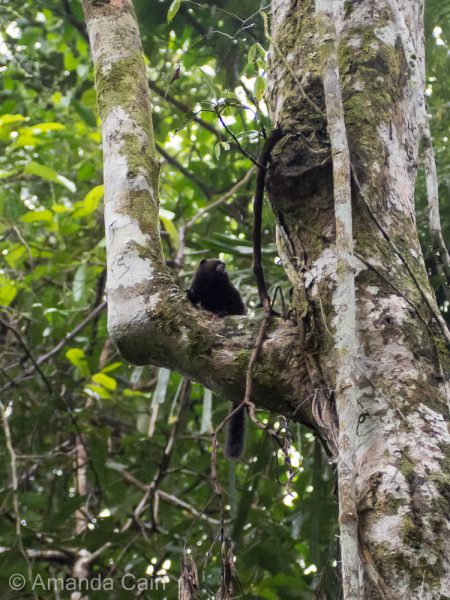
So after two hours paddling along we got off the boat and went for a jungle walk and got to see some monkeys bouncing around in the trees. They moved so fast and jumped so far you would think that they were birds flying through the trees.
Giant Otters
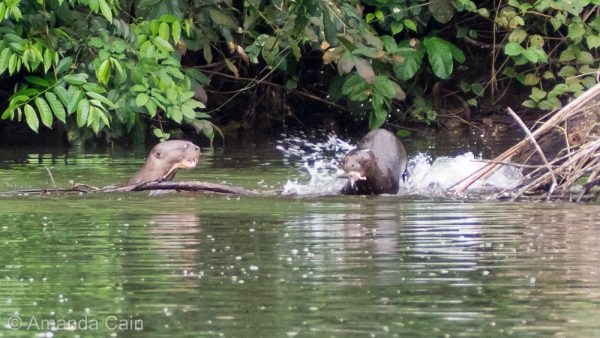
After our walk we went back to the boat to try again for the otters. We were only supposed to have a 2 hour trip on the catamaran, but since there weren’t many people in the next group they were nice enough to let us join them for a second trip. And it was just as well, because within about 15 minutes the guides had spotted the otter family across the lake. It also helped that the rain stopped. We got to see them fishing together as a group, popping up to squeak signals to the others. And when one caught a fish the youngest would then follow them, squeaking demands that they share the fish with it. Eventually the young one got so desperate that it snuck up on an older sibling and stole the fish while it was still eating. All hell broke lose with a lot of splashing, squealing and fighting.
After our trip on the lake we had some more jungle walks searching for more monkeys, this time it was howler monkeys. They make a very strange noise, nothing like a howl at all. It’s more of a very low growl/rumble that sounds a bit like a horde of zombies. The noise wasn’t too bad during the day, but at night it was the one noise I could always hear while I tried to drop off to sleep. Zombies coming to get me from the depths of the jungle.
Day 5 – Back Down The Manu River
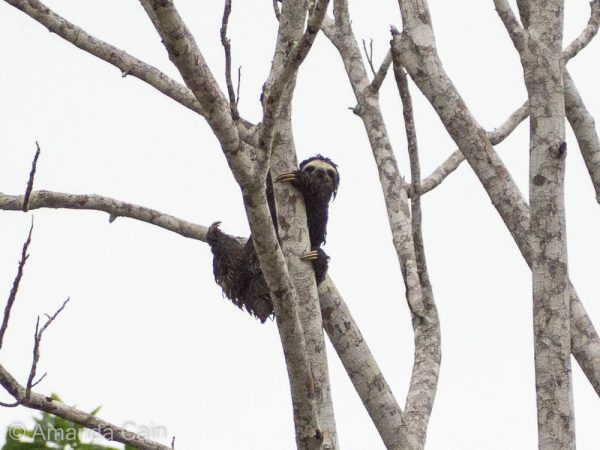
After our day exploring the upper section of the Manu River it was time for us to head downstream again and back to the Madre de Dios River. Unfortunately it was another very rainy day, so once again the RAINforest animals hid from the rain and we didn’t get to see much. Apart from a sloth. It was bedraggled and soaking wet, hanging out in a bare tree. I presume we saw it because it wasn’t able to move fast enough to get out of the bare tree and under cover away from the rain.
From our next lodge we hiked up to a clay lick where we camped out for the night to spot tapirs. They’re normally pretty shy and only come out at night. The clay licks are the one place where the guides know they will be regularly. They eat the clay because unripe fruit has poisons in it, and the clay neutralises them.
It was a really nice night. We stayed in a treehouse with mattresses and mosquito nets. We had to wait silently so we wouldn’t scare the tapirs, but we could sleep while Juanjo kept a lookout for us. It was nice and relaxing listening to the sounds of the jungle (no zombie howler monkeys here) and drifting off to sleep. After 4 hours a big tapir came along to get a good clay dinner. It didn’t stay for long and when it was heading off it almost got stuck in the thigh high clay.
Day 6 – Macaws Galore
Manolo
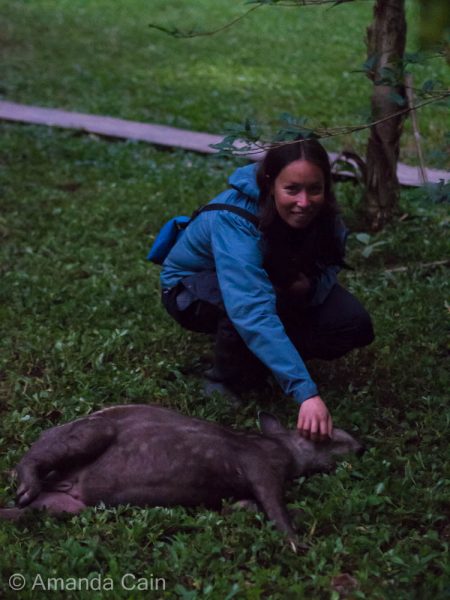
After our night in the treehouse we were up early to visit another clay lick, this time one for parrots. As we were getting ready to leave the lodge a medium sized dog came bounding up towards us. As it got closer and into the light we could see that it was actually a young tapir. He came right up to us, with no fear and sniffed around our legs and feet looking for food. We later found out that he was a semi-wild orphan called Manolo. The workers at the lodge didn’t know where his mother was, so they had adopted him and gave him leftovers from breakfast and dinner. He wasn’t tied up and came and went into the jungle as he pleased, but was obviously used to people and had no fear.
We hope that he doesn’t get reliant on the free food from the lodge and eventually goes into the jungle and stays there. We made sure we didn’t feed him, but couldn’t resist giving him a scratch which he really seemed to enjoy.
Clay Lick For Parrots
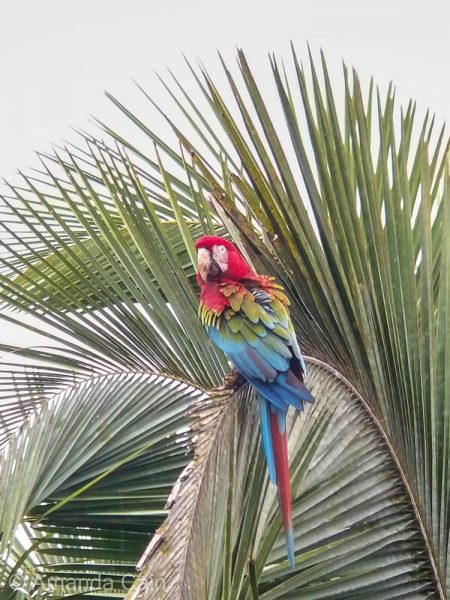
After saying goodbye to Manolo it was off to the clay lick. It’s not just for macaws. Other parrots and even some mammals come along. The different birds all go down to the clay at different times. First up are the blue headed parrots. They spent at least an hour in the trees above the clay lick before finally getting the courage to go down. Jaguars and other big cats know that the birds go there everyday. So sometimes they’ll be waiting for them. Once the first couple of parrots safely make it to the clay, then the whole flock follows after them.
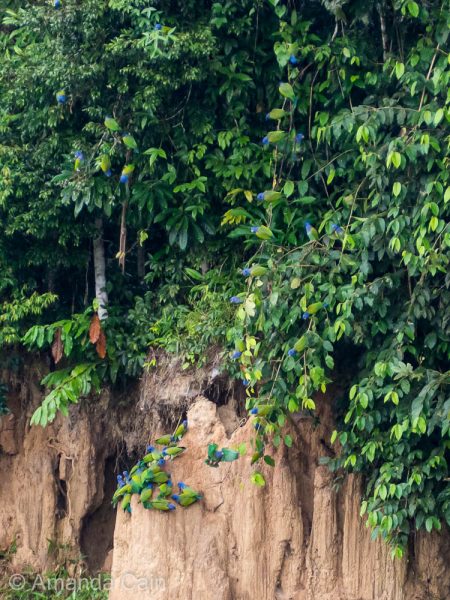
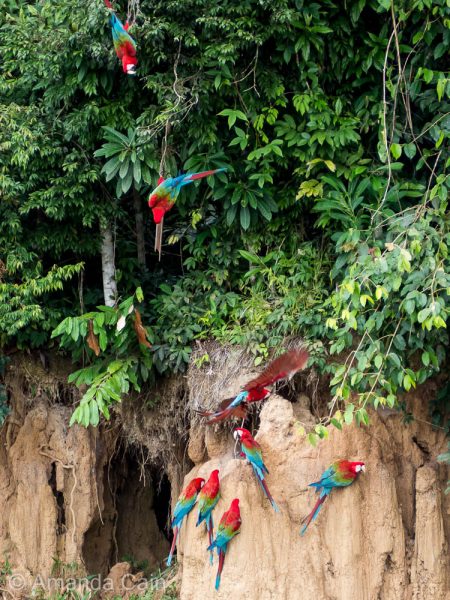
Once the blue headed parrots were done, it was time for the little parakeets. Like the blue headed parrots, they slowly worked their way down as a group before deciding it was safe to get some clay. Then it was quiet for a long time. Then, one by one macaws flew in and waited high in the treetops. Eventually when there were enough of them they also slowly made their way down to the clay. Then lots of loud squawking and colourful flapping as they argued with each other for the best position.
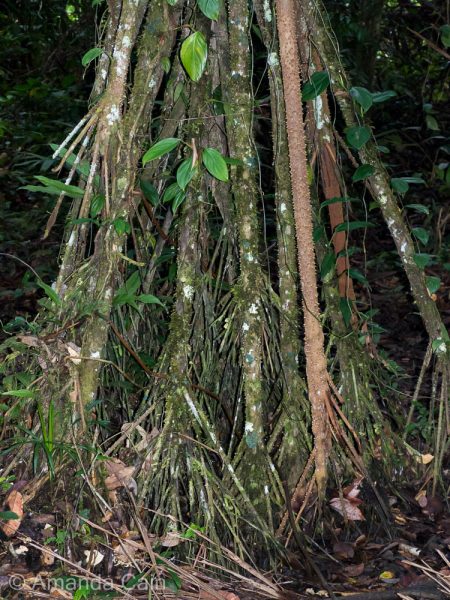
After our morning at the clay lick we had enough time for one last hike through the jungle. One of the things we found was a walking tree. They have a strange root structure and scientists think that the roots slowly pull the tree along the ground so that it can move to a better location.
Day 7 – Time To Say Goodbye To The Jungle
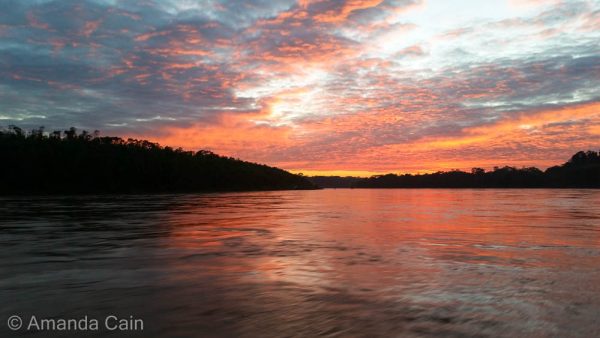
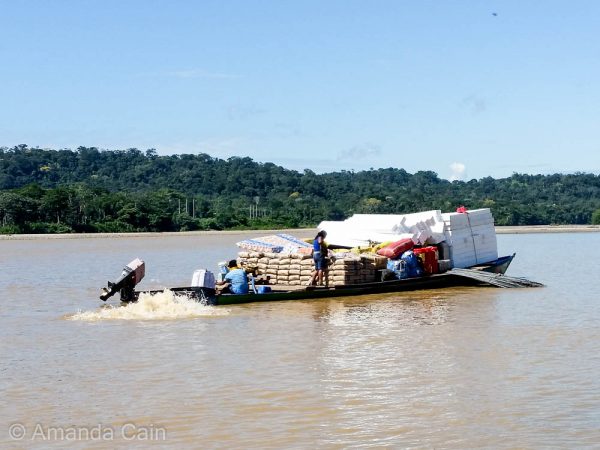
On our last day we were back on the boat before sunrise again because we had a very long day of travelling to get back to Cusco. The jungle put on a spectacular sunrise for our last day. And we got to see another family of capybaras with a little tiny baby bouncing around the parents. After that there wasn’t any time to slow down and look for animals, it took us two boat rides and two car trips to eventually get back to Cusco 12 hours later. (It probably would’ve taken 18 hours if the last van driver followed the speed limit!)
The jungle was different from our Galapagos trip because you really had to look hard to find animals. Even though there are so many big and brightly coloured animals in the jungle, the trees and plants are so thick that the animals disappear quickly. We had a great time in the jungle looking for cool animals and it was a shame that it felt like it was ending so soon. Maybe we’ll go back another time!

Such a wistful feeling, reliving the jungle life…
And the nice soothing sounds of the emergency headlamp…
Every time I see pictures of you in your poncho, I hear that sound.
just beautiful
What an adventure that must have been., Amanda and Pedr.