We’re back from Cuba now, so that means internet access again, and some more posts. Still got a bit more work to go on the Cuba photos. But for now here’s a post on the ruins of Palenque that wasn’t finished before we left.

The ruins of Palenque are absolutely fantastic. While there were some pretty cool ruins in central Mexico, and some others we’ve seen that haven’t been in a post yet (Chichen Itza & Uxmal), Palenque has been our favourite so far. Maybe it’s the thick jungle surrounding the area that makes it seem like a lost city. Or the fact that some of the ruins have been preserved with trees still growing out of them. But Palenque has that special something that makes it magical.
Palenque’s Iconic Temple of the Inscriptions

This is probably the most photographed and iconic building in Palenque. The ruler Pakal the Great was buried in here in a giant stone sarcophagus with his famous death mask of jade.

Before, you could climb up the temple and go inside the tomb. But because of the damage caused by all the visitors they’ve closed off the entire building. But they’ve recreated the burial chamber in the museum so you can get an idea of what it was like. The giant sarcophagus is there too so you can get a good look at the detailed carvings on it.

Next to the Temple of the Inscriptions you have a smaller temple with the Tomb of the Red Queen inside. They think she was the wife of Pakal the Great. The reason she’s called the Red Queen is because everything inside her sarcophagus was covered with bright red cinnabar powder. Her tomb is still open so you can go inside and have a look.

The Palace of Palenque

The rulers of Palenque lived here and added different sections and decorations during their reigns. Some of the buildings still have carvings and some painting still preserved. And there are quite a few roofs still standing. (A common problem with Mayan ruins seemed to be that over time the front fell off.) But the building that stands out the most is the observation tower.

Archaeologists aren’t 100% sure it was used for astronomy. But they think it was pretty likely. The Mayans were pretty good at astronomy (observing the movement of planets and stars). And they were the only civilisation in the Americas that realised that the morning star and evening star were both the same planet: Venus. They also liked to make a lot of predictions about the future using their knowledge of the stars and planets (astrology). So it makes sense that an observatory would be in the royal palace.

Temples of the Cross Group

The temple-pyramids in this plaza were all built by Pakal the Great’s sons and grandson. The archaeologists have only cleared the buildings themselves and the plaza. So you still have jungle creeping up to the sides of the buildings. It looks like what you might expect a lost city in the jungle to look like. At the tops of the pyramids, in the temples, are some impressively detailed carvings of ceremonies and rulers.

Unfortunately you can’t go inside to get a good look at them. But the museum has the originals and you can get up nice and close to those.

One thing you might have noticed is that the Mayans have pointy heads in these carvings. We thought it was just an artistic style until we saw a facial reconstruction from an actual skull (in a different museum).

Another thing the archaeologists found here were more than 100 incense burners, and you can see them in the museum too.

Palenque: Lost City in the Jungle
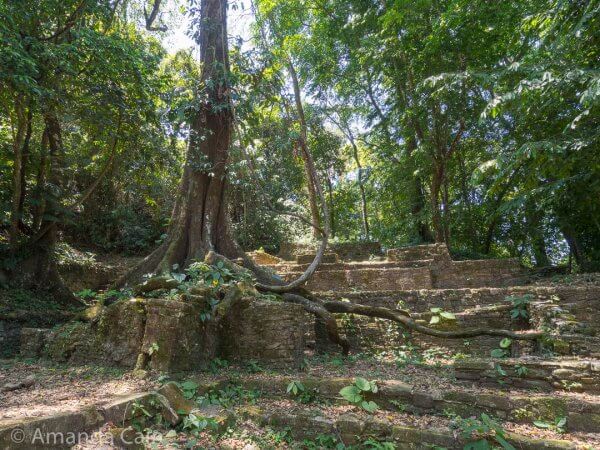
The Temple of Inscriptions, Palace and Temples of the Cross group are the main sets of ruins in Palenque. There’s also the Ball Court, Temple of the Count and the North Group, a group of smaller temples, but they don’t know much about them.

Altogether these ruins are only a small part of all the ruins in Palenque. A lot of the small temples are still in the jungle, partially or completely unexcavated. As well as plenty of houses. So you follow these paths through the thick green jungle and come across ruins and trees sprouting out of the middle of them.

I haven’t played the game Uncharted, but Pedr says that walking around Palenque felt a lot like being back in the game. He also said it felt like the whole lot was going to go up in a big explosion as we walked away.

We still have a few more ruins in Mexico (plus more in Belize, Guatemala and Honduras) to explore so we’ll see if any of them will become our new favourite. But for now we would say that if you could only see one set of ruins in Mexico, it should be Palenque.


Very well researched and thought of Amanda/ Pedr, fascinating views and histories behind about people and culture.