Most people associate Belize with reefs and tropical island paradises, but it also has quite a few Mayan ruins. These include the powerful city of Caracol, and Lamanai; the city occupied for 3000 years. There’s also the Actun Tunichil Muknal cave (or the ATM cave as everyone calls it) that the ancient Mayans used for human sacrifices. As well as plenty of smaller sites.
Caracol

This was once a powerful city in Mayan times. It was allied with Calakmul against Tikal (two of the most powerful Mayan cities). Nowadays it’s in the middle of the jungle near the border with Guatemala. And 3 hours down a dirt road from the nearest town. It’s a big site, and because it’s so remote you hardly have to share it with anyone. We saw three other groups while we were there.
The total site is huge (200 square km), but only parts of the central area have been excavated. A few years ago they did some aerial laser mapping where they could see the foundations of buildings and roads. Even though the whole area is covered in thick jungle. This is how they know how big the site is. They think that at its peak 120,000 people lived here. For reference, that’s one third of the current population of all of Belize. They didn’t really start serious excavations until the 1980s, so there’s still a lot to investigate.
The Sky Palace (Caana)
The largest and most impressive building here is the Caana or Sky Palace. Which is the largest man-made building in all of Belize.

At the top of the pyramid are smaller pyramids that were used as burial tombs for the elites of Caracol. You can go inside and look. The burial chambers are actually pretty small. They’re just large enough for a coffin / sarcophagus, and a couple of metres deep.
When you climb to the top of the pyramid you can get a nice view out over the endless green jungle. You can even see the mountains that mark the border with Guatemala, just a few kilometres away.
Rain God

Opposite the Sky Palace is a small pyramid-temple dedicated to the rain god with “masks” of the rain god next to the stairs. What’s interesting about these is that they have decorations and images of the rain god of the Mexican highlands (a very long way from Belize!). The people of Caracol needed rain so badly (because of a severe drought) that they were willing to worship any rain god they could find.

In an older section of the site there is a plaza with pyramids & temples around the sides. They think that one of the buildings may have been used for astronomy because of all the doors and windows placed around the sides of the building.
Modern Day Altars
Even though there haven’t been any people living here for a very long time, the site is still sacred to the modern day Mayans. (The ancient Mayans weren’t all killed off by the Spanish.) So as we walked around the site, we could see small ceremonial altars in front of several temples. Our guide explained to us that these were modern constructions put there by the government. So the local Mayans can come and perform ceremonies and rituals at their sacred places. (Their religion is a blend of Christianity and ancient Mayan beliefs.) We thought it was a nice way to accommodate both the Mayans and the archaeologists.

Actun Tunichil Muknal Cave (ATM Cave)
This is a pretty amazing site because it’s completely different to the other Mayan ruins we saw. You can’t tell it’s a Mayan site until you’re deep within the cave where they did the human sacrifices.

To get there; it’s a hike through the jungle, swimming across three rivers before finally arriving at the entrance to the cave.

Once you swim through the pool at the entrance you then climb and swim your way through passages, past beautiful limestone formations before arriving at the main chamber. Once you get here you have to walk in socks to prevent any damage to the cave floor. There are Mayan pots and skeletons lying in different places all through the cave. (You’re also not allowed to take any electronic equipment into the cave, apart from headlamps. Because some of the pots and skeletons have been damaged by people trying to take photos. And this is why we can’t have nice things…)

Why the Sacrifices?
They think that the ancient Mayans first brought the clay pots into the cave to perform ceremonies to ask the rain god to end a long drought. As the drought worsened the Mayans got more desperate and brought in human sacrifices.
They think that this severe drought was what caused the end of the golden age of the Mayans, and nearly ended their civilisation. Even many powerful cities like Tikal and Calakmul were abandoned at this time. Some areas weren’t affected as badly and they built cities like Chichen Itza.

As you walk around the main chamber of the cave you can see why the ancient Mayans thought that the rain god lived here. The cave is full of pools of water in the rainy season, and many tall and intricate limestone formations all around the sides, hanging from the ceiling and sticking up from the floor. With water dripping down all over the place. Because the skeletons have been there for so long they’ve become coated in limestone as well.

They’re not sure who the sacrificial victims were. They could have been friends or enemies. But they would’ve been important people; like royalty, nobles or priests. Because they believed that the gods demanded their “powerful” blood. After seeing so many Mayan cities it was very interesting to see a sacred site like the ATM Cave.
Cahal Pech
Cahal Pech is a smallish site sitting on top of a hill, with a good view of the area around it. It’s only a 15 min (steep uphill) walk from the centre of San Ignacio. So it makes for a nice couple of hours trip. It’s almost like a small Mayan town. Except that it was actually the home of an elite Mayan family. One (very large) family built all these temples, pyramids and palaces.

While we were there there was a group of archaeologists digging into one of the plazas because they had discovered buildings buried underneath. They told us that the top section of the hill wasn’t natural. That the entire central part of the site (~20,000 square metres) had been artificially raised by several metres, so that they could build new buildings on top of this new raised surface. They would’ve done that as part of their ceremonial rebuilding. That’s a pretty damn impressive effort.

Lamanai
This wasn’t one of the biggest or most powerful Mayan cities, but it was one of the longest lasting. It was occupied for over 3000 years, right up until the 1700s. The Mayans here actually drove off the Spanish missionaries who were trying to convert them. The city is built on the banks of a large lagoon. So the people here wouldn’t have been affected by the severe droughts that brought about the end of the much more powerful cities like Tikal and Calakmul.
In fact, the main way to reach the ruins of Lamanai is to take an hour long speedboat ride down the river. It’s a nice ride and you can spot wildlife along the way.

They’ve only uncovered a small portion of the buildings at Lamanai. But the large pyramids & temples have been partially restored and you can climb up them if you want. (We like the way the Belize government has done this. You can’t climb up the front staircase but they’ve built a wooden staircase around the side & back of the pyramids. This way they can protect the pyramids from erosion caused by too many tourists. But people can still climb to the top using a comfortable modern staircase.)
Lamanai’s Temples
The three main pyramid-temples you can see are: the Jaguar Temple, the High Temple and the Mask Temple.
Jaguar Temple

The Jaguar temple gets its name from the two jaguar “masks” at the bottom of the pyramid.

High Temple
The High Temple is the tallest pyramid at Lamanai (it’s not a very original name).

This is also the place we were lucky enough to see three howler monkeys in the tree right next to the staircase.

Mask Temple
And the Mask Temple got its name from the two plaster masks of people at the base.

They think that this temple may be an ancestor temple that was used as a royal tomb. And that the masks represent an early king. Inside the temple are tombs that contained luxury jade and shell jewellery, which is why they think they were kings. The masks are from around 400 AD and are in pretty good condition. But the masks that you see here aren’t the real ones, they’re fibreglass copies. The real ones are protected underneath the fibreglass layer.

It’s a nice way to protect them because you can see how the whole temple used to look without roofs all over the place. (In most places archaeologists have built small thatched roofs over the plaster decorations. But this kind of takes away from the overall look of the building when you have these little roofs all over it.)
Altun Ha
This is a smallish site (at least the part you can walk around) with two main clusters of buildings around plazas, and a path leading to a large pond. The biggest building, the Temple of the Masonry Altars, is used as the logo for the Belizean beer: Belikin.

Apart from that the site itself isn’t that impressive, from a monument point of view. But in the Temple of Masonry Altars they found the tomb of a very important person because he was buried with the largest Mayan jade object ever found: a huge 4.4 kg carving of the head of the Jester God (this was the god associated with kings and queens). This is such an important artifact that there is a small picture of it on all of Belize’s money. Unfortunately you can’t see the real one; that’s kept deep in a vault somewhere. But they have a replica at the site so you can see what it looks like and how big it is.

Visiting the Sites
Because Belize is a fairly small country, pretty much everywhere you go there will be people offering day trips to any of the sites all over the country. Including day trips from the islands.
Generally Lamanai and Altun Ha are easiest to visit from the northern part of the country. Caye Caulker / San Pedro are a little more inconvenient bases for visiting these ruins. But it’s still doable in a day.
Actun Tunichil Muknal (ATM) Cave, Caracol and Cahal Pech are best visited from San Ignacio or the western area of Belize.
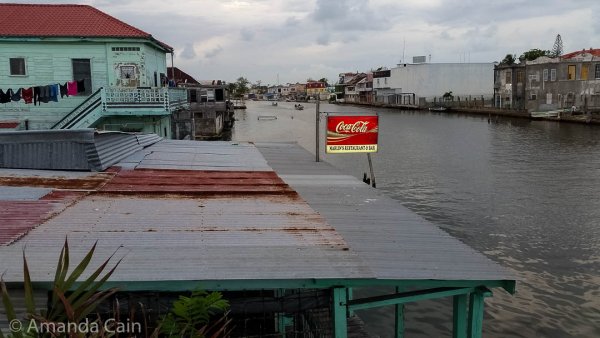
It’s not worth basing yourself in Belize City like we did for a few days. In short: Belize City sucks. There’s nothing to see there, you don’t really save much money on transport and the city is pretty sketchy in some areas. You’re better off enjoying yourself on the islands, San Ignacio or Crooked Tree.


Leave a Reply