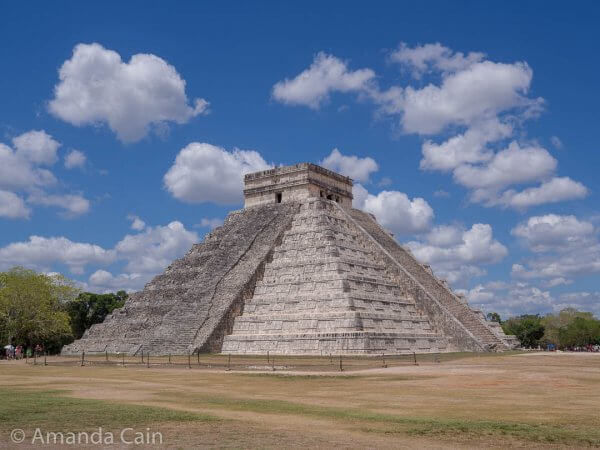
Mexico has a ton of pre-Hispanic civilisations and ruins, with the Mayans controlling the largest area and having the most towns and cities. You don’t realise just how many and how big the cities were until you see them yourself. We spent a lot of time travelling around the Yucatan Peninsula in Mexico visiting a LOT of Mayan ruins, and this post is a little taster of the various Mayan ruins you can visit in Mexico. (There are still plenty more that we didn’t visit.)
If you’re interested in Mexico’s non-Mayan sites check out this post on the ruins of central Mexico.
A Little Bit About the Ancient Mayans
These were a group of people who lived in Central America (Mexico, Guatemala, Belize, Honduras & El Salvador). They built huge cities, pyramids, temples, ceremonial ball courts and were technologically advanced. Their civilisation reached its peak between 250-900AD. Each city had its own king or queen and they were pretty much at war with each other all the time. They built cities everywhere, and during their peak archaeologists think that there must’ve been 50,000 – 120,000 Mayans living in the largest cities. So there would’ve been several million altogether.
After their civilisation declined, probably because of severe droughts, the Mayans abandoned their great cities and were later conquered by the invading Spanish. In the 500 years since then the jungle swallowed their cities, but they are slowly being rediscovered and excavated.

Here’s a visual guide on the most famous and less famous ones in Mexico. (Warning: lots of pictures!)
Mayan Sites
-
- Chichen Itza
- Tulum
- Uxmal
- Ruta Puuc Sites (Kabah, Labna, Sayil & Xlapak)
- Calakmul
- Becan
- Rio Bec Sites (Chicana, Xpujil, Hormiguero)
- Palenque
- Edzna
- Dzibilchaltun
- Wildlife
Chichen Itza
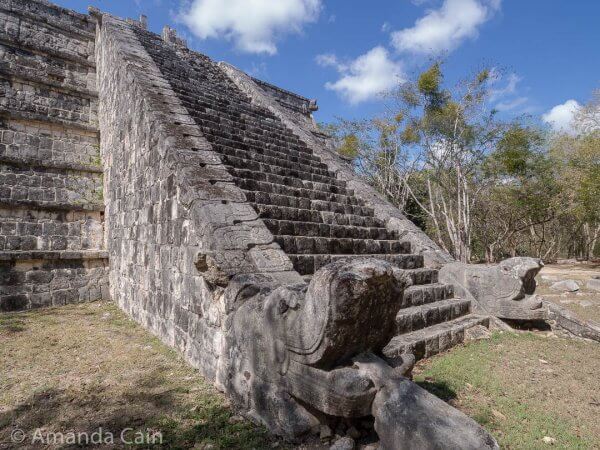
Intertwined snakes along the sides of a staircase.
This is probably the most famous set of ruins in Mexico. Chichen Itza has even made it onto the list of the New 7 Wonders of the World. It’s also pretty close to Cancun, so it’s super popular.It’s not hard to see why. You have the iconic pyramid temple, El Castillo, which was mostly intact when archaeologists began excavating it in the 1920s. If you go during one of the equinoxes, then you can see a “serpent” made of light and shadows going up/down the stairs at sunrise/sunset.
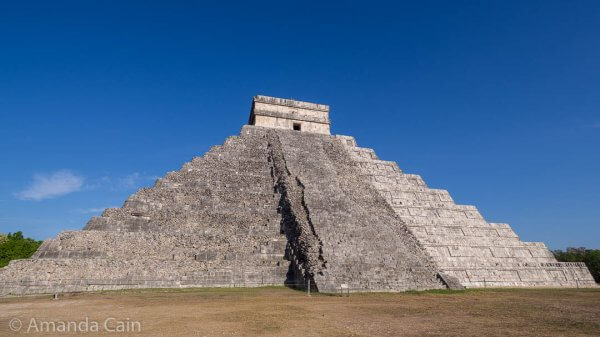
A close up of the unrestored section (left & centre) of El Castillo at Chichen Itza. As you can see, it’s still in pretty good shape.
There’s also the Great Ball Court which is the biggest in all of Mesoamerica. The rules for the game were different for each city (ball courts all have different shapes and sizes), but generally involved hitting a 4kg solid rubber ball through hoops without using their hands. It was a symbolic religious event, and the losing team could be sacrificed to the gods.
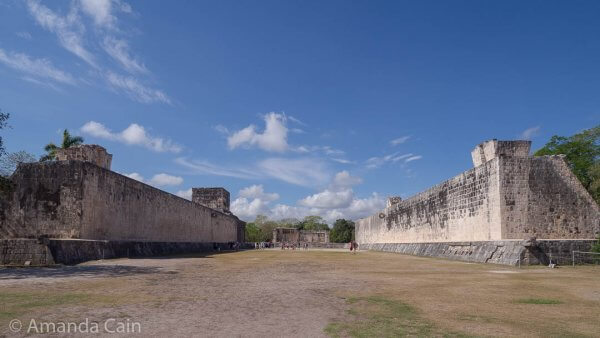
The Great Ball Court of Chichen Itza. At 168 metres by 70 metres, it’s the largest of the Mesoamerican ball courts. If you look halfway along the the sides of the court, near the top you can see a (tiny) stone ring on each side. The players had to hit a 4kg rubber ball through this hole without using their hands.
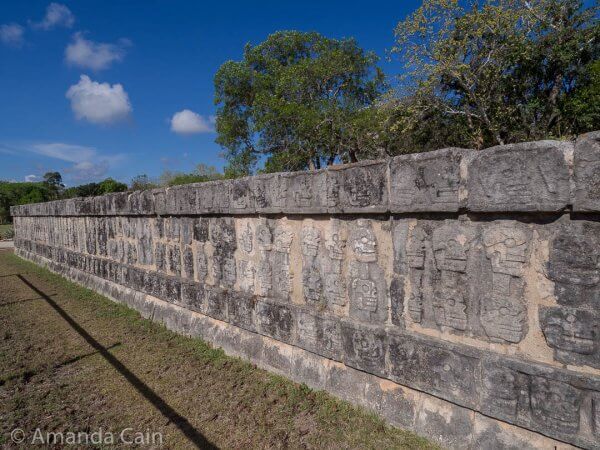
This stone platform is where the Mayans displayed the severed heads of the players that were sacrificed to the gods after the ball game. As you can see it’s quite large. So the Mayans would have accumulated a lot of heads over the centuries.
Another iconic building is the Observatory. The shape is a bit like a modern observatory, and archaeologists think that the doors and windows inside it were put in specific locations so that they could observe important events in the movement of the planet Venus.
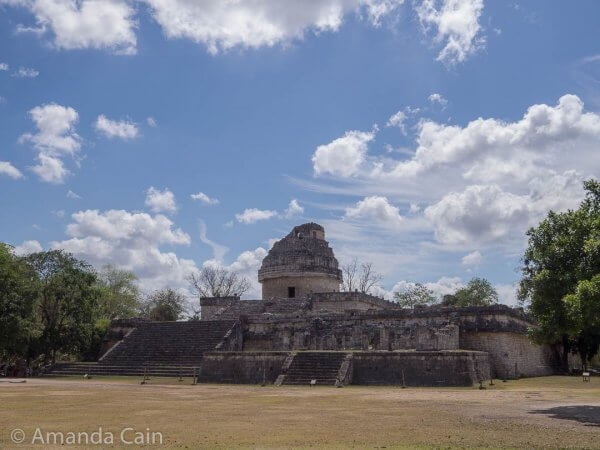
The Observatory of Chichen Itza. Archaeologists think that the Mayans built it to make astronomical observations (in particular, Venus) because of the positions of the doors and windows of the building.
El Castillo, the Great Ball Court and the Observatory are all impressive buildings, but there are also plenty more well preserved and decorated buildings throughout the site that you can see in the pictures below.
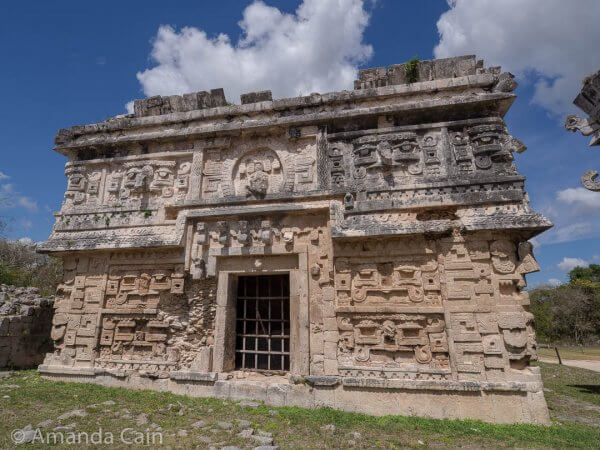
One of the richly decorated buildings in Chichen Itza. You can see faces on all the walls, the roof, and the side edges of the building.
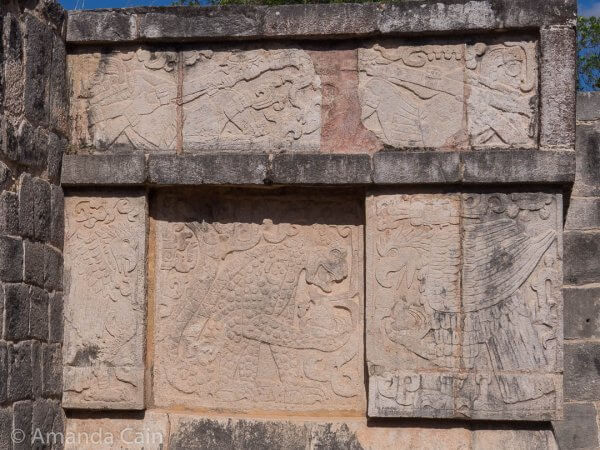
In this carving from Chichen Itza you can see an eagle and a jaguar (both sacred animals to the Mayans) eating human hearts. Tulum
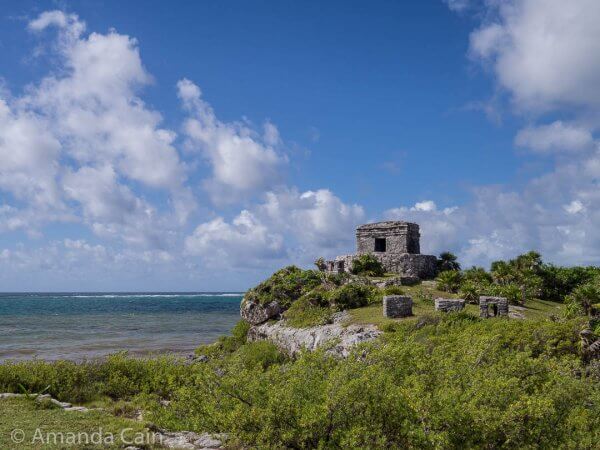
The Temple of the Wind God perched high on a cliff. You can see some small mini-temples nearby.
Tulum seems to be overhyped, probably because it’s right next to the beach. It’s not a bad set of ruins, but it’s visited by far more people than plenty of more deserving locations that we saw. (One of the info plaques there actually called the buildings of Tulum “simpler”, “less elaborate”, “rougher quality” and “lacking the imposing pyramids and complex mosaic facades” of other Mayan ruins. Ouch.)
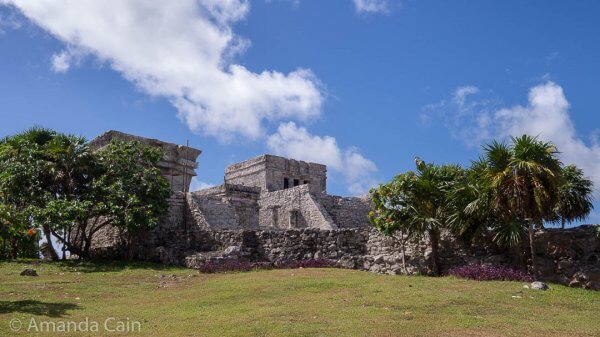
The tallest building in Tulum: El Castillo (The Castle). It’s a pyramid with a square-shaped temple on top. Unfortunately you can’t get anywhere near it.
There’s a few smaller temples and a pyramid built right on the cliff top overlooking the sea. It’s a nice scenic location, and an easy visit if you’re in the area.
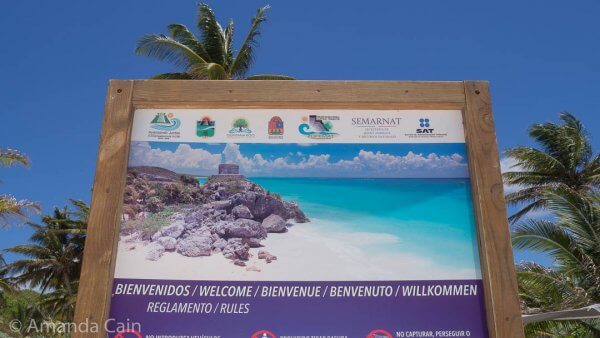
Here’s the iconic photo of Tulum that you see in all the advertising.
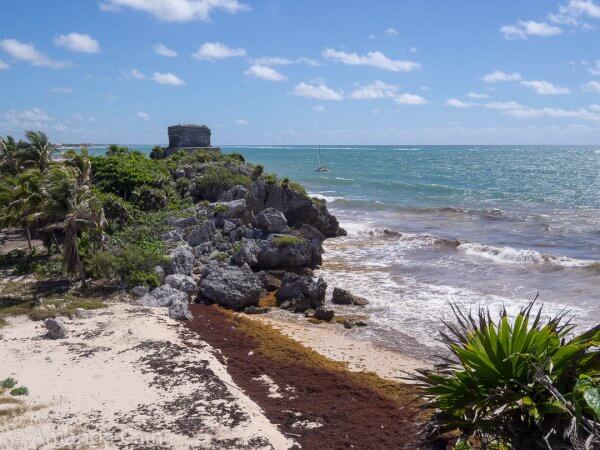
The iconic shot of Tulum ruins. Except it’s the middle of seaweed season, it’s windy as all hell, and waves are crashing down on the shore rather than gently lapping the shore. Uxmal
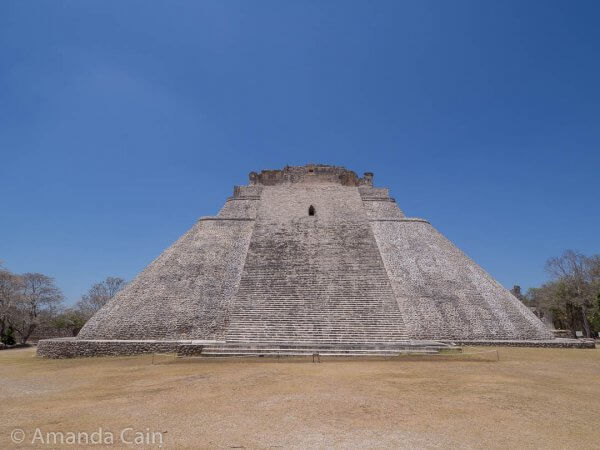
The Sorcerer’s House in Uxmal.
Uxmal is another important and impressive Mayan city. It’s a little bit out of the way to get to, but it’s definitely worth the hassle. The first thing you see when you enter is the Sorcerer’s House, which is a huge pyramid with rounded sides and a decorated temple on top.
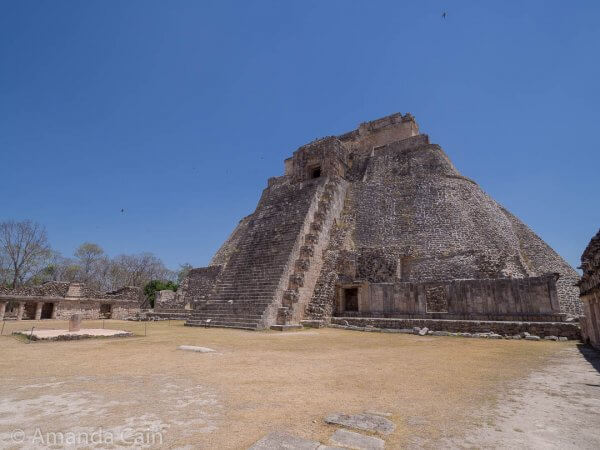
The other side of the Sorcerer’s House.
Right behind it you have the House of Birds, where the roof is decorated to look like a thatched roof and then they’ve put carved birds all over the “thatching”.
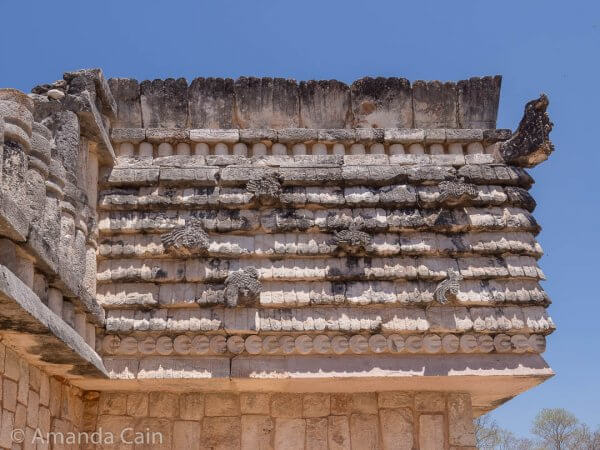
The top of this building is designed to look like a thatched roof with birds all over it.
Around the corner from the Sorcerer’s House is an area that had four large buildings which may have been palaces for different noble families. Each palace has its own style of eleborately carved decorations on the front.
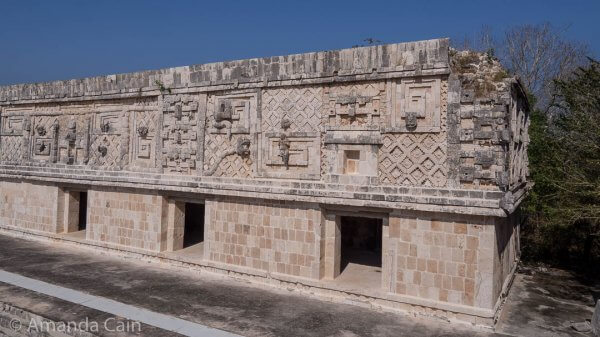
One of the palaces surrounding the Nun’s Quadrangle in Uxmal.
On the other side of the city you have the Great Pyramid (which you can climb for a good view) and the Governor’s Palace.
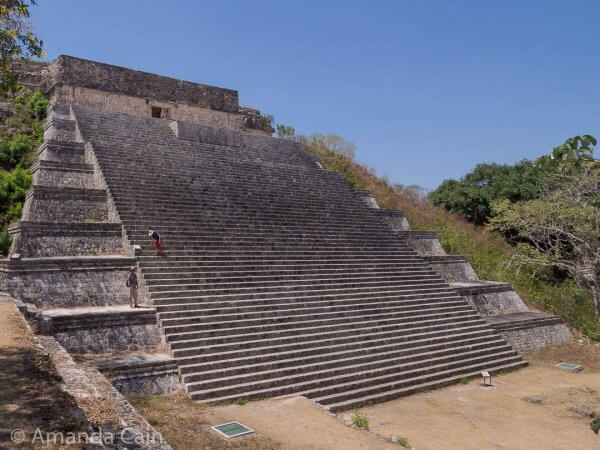
The Great Pyramid of Uxmal. The climb is pretty difficult in the middle of a 42°C day.
The Governor’s Palace is an impressive building with elaborate decorations all along the top of the building. Nearby is also the double-headed jaguar throne used by the governor/ruler.
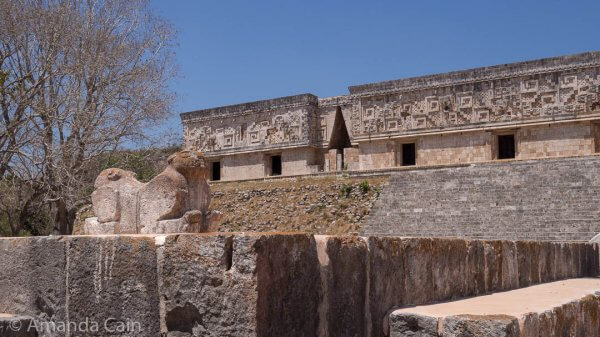
The Governor’s Palace of Uxmal, with the double headed jaguar throne in front.
What’s really amazing for this city is that it used to have 15,000 people living here, but there are no permanent sources of water. So for six months of the year, the Mayans here had to rely on underground cisterns that they built which collected the rain during the rainy season.Ruta Puuc Sites (Kabah, Labna, Sayil & Xlapak)
These next sites are all smaller towns that were ruled by nearby Uxmal. And like Uxmal, they had no permanent water supply. (I am constantly amazed by this fact.)
Kabah
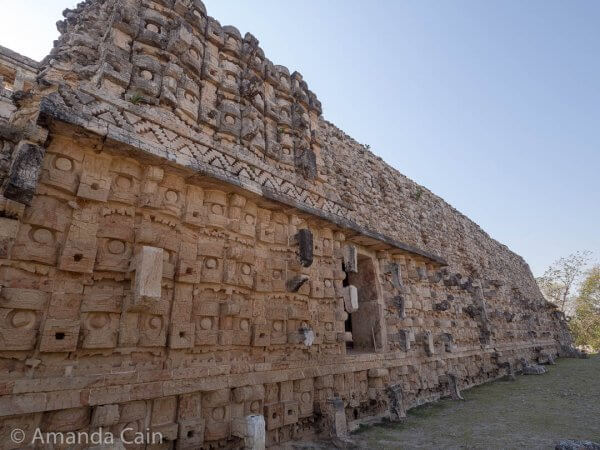
The Palace of the Masks in Kabah. The entire surface of this building is covered in “masks” representing the rain god Chaac.
This town is split in two by the modern highway, but it has some beautifully decorated buildings. The most impressive is the Palace of the Masks, which is a building covered in faces or “masks” of the rain god Chaac.
There are also a few other decorated palaces that have been restored. But the majority of the site is still covered in trees and shrubs, including the Great Pyramid which you can see poking up through the trees on the other side of the highway.
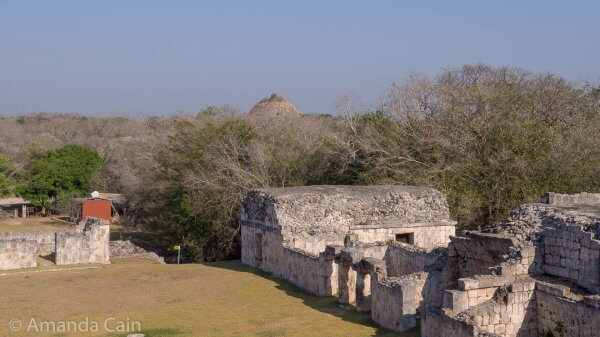
Very little of Kabah has been excavated. In this picture you can see a pointy thing in the background sticking up over the trees. That’s the Great Pyramid of Kabah, still unexcavated. Labna
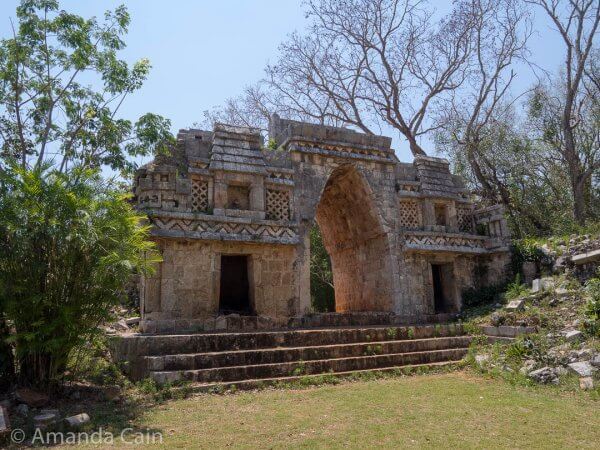
The great arch of Labna.
This is a fairly small site, but the two main things to see here are the palace and the impressive stone gateway. Both have beautiful decorations.
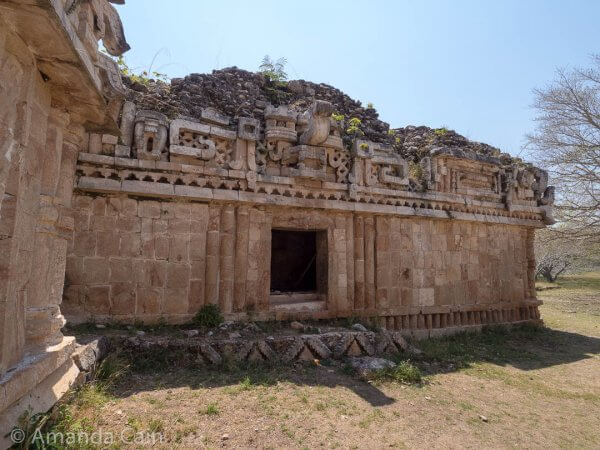
Part of the Palace of Labna. Sayil
This is a pretty big and spread out site, but the main thing to see in the very large Great Palace.
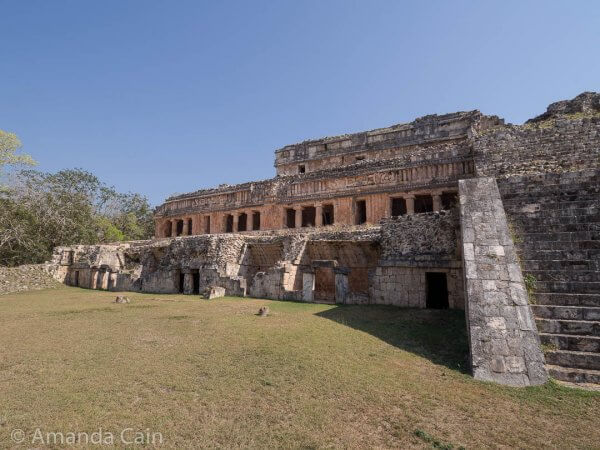
One half of the Great Palace of Sayil. Xlapak
This site is pretty small, but has a few small buildings decorated with “masks” of the rain god Chaac.
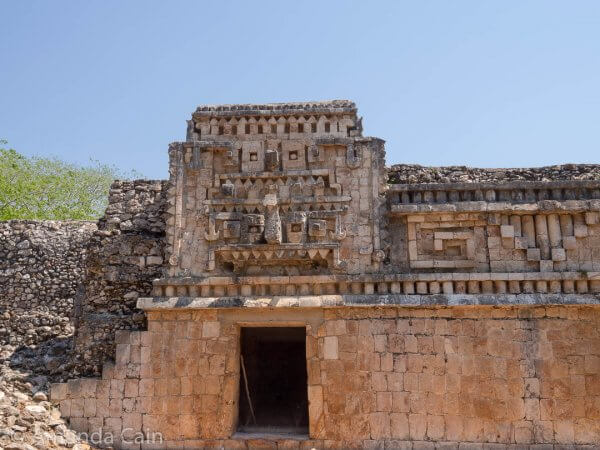
A palace at Xlapak with a mask of the rain god Chaac above the door. Calakmul
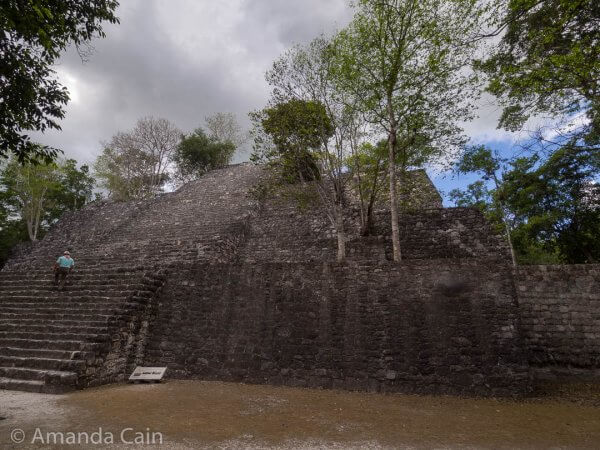
One of the “smaller” pyramids at Calakmul. From the top of here you can see the two big pyramids sticking up out of the jungle.
This is probably one of our favourite ruins in Mexico. Because it’s deep in the jungle and fairly remote, you don’t have to share the site with many people.
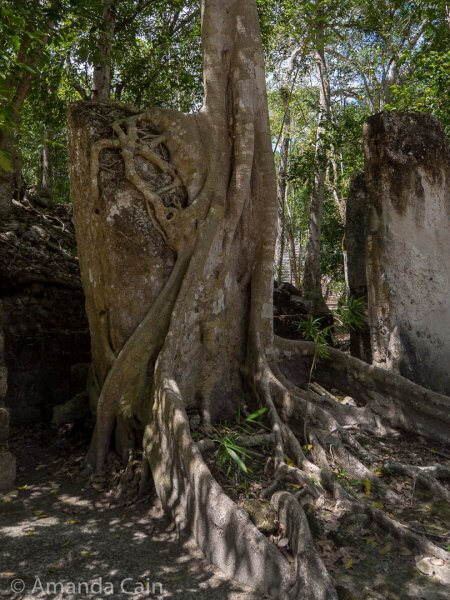
A tree wrapped around a carved stone stela and trying to “eat” it.
So you definitely feel like you’re an explorer discovering a lost city. Fun fact: Calakmul gets the same number of visitors in a year that Chichen Itza gets in a day.
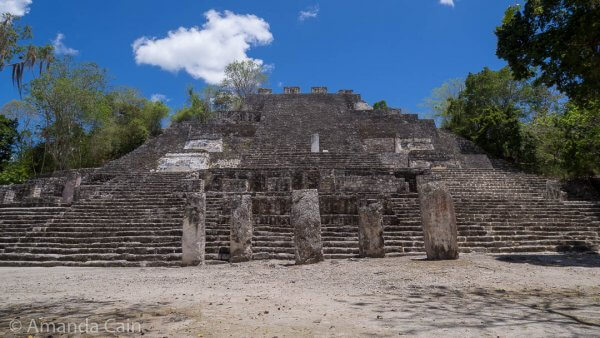
The massive pyramid of Structure 2 in Calakmul. This is one of the largest Mayan pyramids. The base measures 120 metres x 120 metres and it is 45 metres high. One thing that is not clear from this photo is that the steps are twice the height of normal modern steps. It’s hard work climbing Mayan pyramids.
Even though it’s far away from modern towns and cities, Calakmul used to be a powerful Mayan city with 50,000 people living there. Calakmul and the city of Tikal were two rival superpowers in the Mayan world, and spent a lot of their time fighting one another.Like a lot of powerful cities, Calakmul built a lot of monumental buildings to show off their power. The most impressive are the two huge pyramids: Structure 1 & Structure 2. (Or Big-ass Pyramid 1 and Big-ass Pyramid 2)
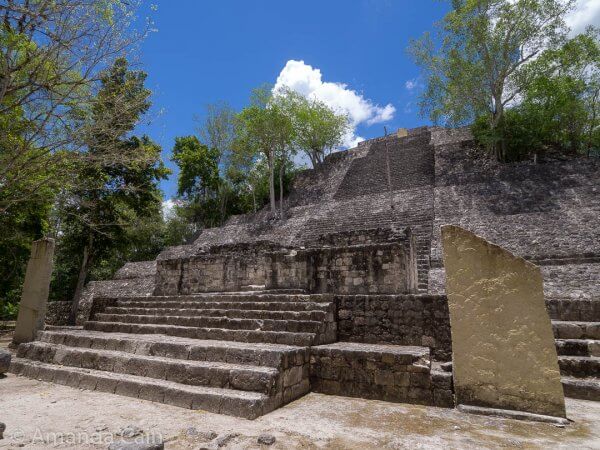
Structure 1 at Calakmul, one of the largest Mayan pyramids. The stairs look like normal size, but they’re twice as tall.
You can climb up the top of both of them for a view over the Great Green Ocean, which is what they call the endless jungle.
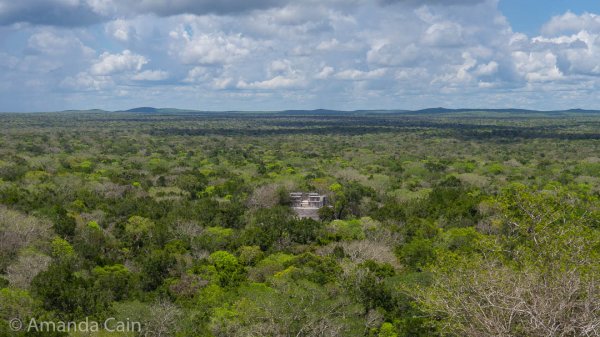
Apart from the handful of Mayan pyramids sticking out of the trees, all you can see for miles around Calakmul is the Great Green Ocean.
When you stand on top of either pyramid all you can see is bright green trees on the flat landscape all the way up to the horizon. The only man-made structures you can see are a couple of pyramids in Calakmul, surrounded by a sea of green. With some help from a guide (and a bit of squinting) you can even see the big pyramid of El Mirador, another Mayan city 70km away, across the Guatemalan border. Standing on top of a pyramid in the middle of the Great Green Ocean really does make you feel insignificant. And it reminds you that one day nature will reclaim the major bustling cities of our modern world.
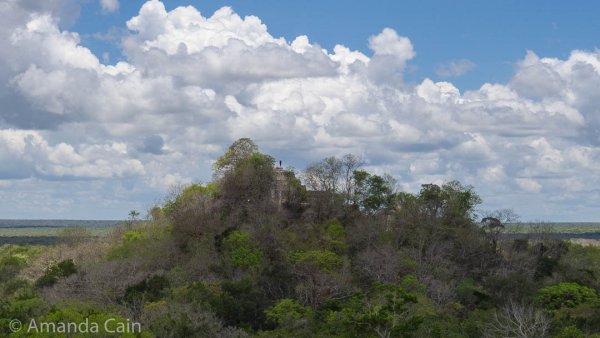
One lone person, on a lonely pyramid in the middle of the Great Green Ocean. Becan
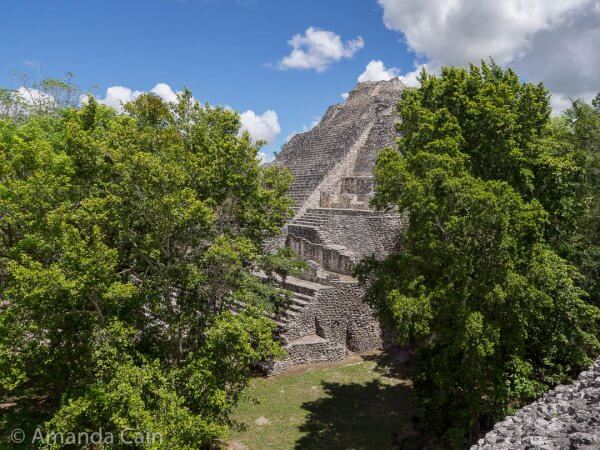
The great pyramid of Becan (or Structure 9 as it’s officially called). It’s 42 metres tall and one of the few buildings high enough to poke out above the thick trees of the jungle.
Not far from Calakmul is another Mayan capital city: the city of Becan. The name actually means “ravine or ditch formed by water”, which describes the moat built around the city for protection.
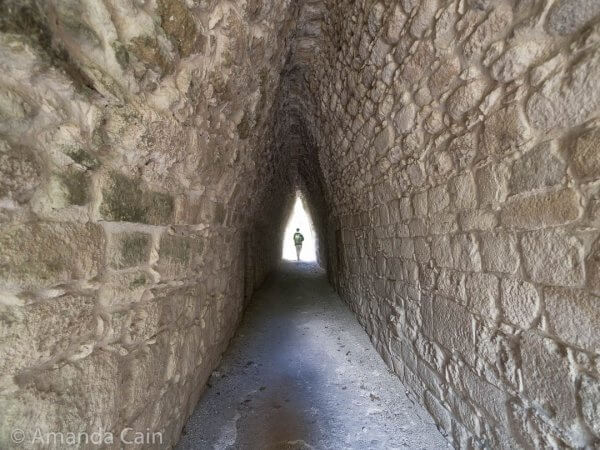
Pedr heading into the light at the end of the tunnel…
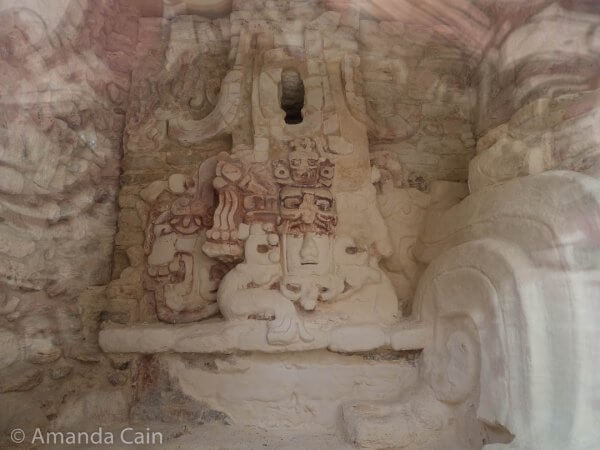
A plaster “mask” of the Mayan sun god. Plaster masks and sculptures haven’t survived well over the years, so seeing this one in such good condition is very special.
The city had two periods where it was powerful (with a decline between these periods). So the buildings are bit unusual because lots of rooms and extensions were added onto existing buildings, rather than building over the top of them like at most Mayan cities. So you end up with a rabbit warren of rooms, stairs and corridors going in different directions in the larger palaces.
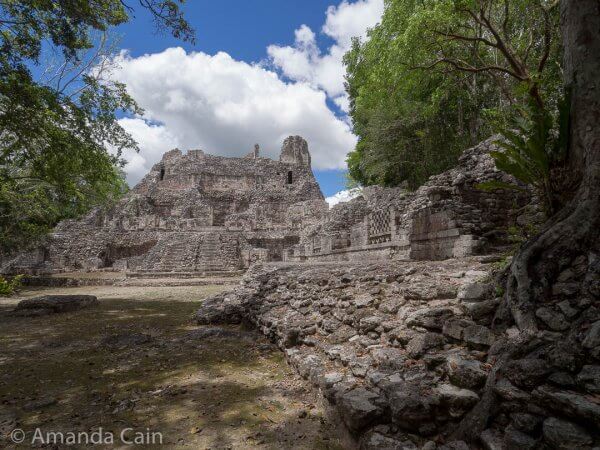
A large palace complex in Becan. It’s been added to over the years, so now when you walk through it it’s a bit like a rabbit warren with rooms, passages and stairs going in all directions.
And of course there are the large monumental buildings like the great pyramid of Structure 9, and the palace of Structure 8. (They really need to come up with some cooler names for these impressive buildings. Structure “so-and-so” doesn’t sound worthy.)
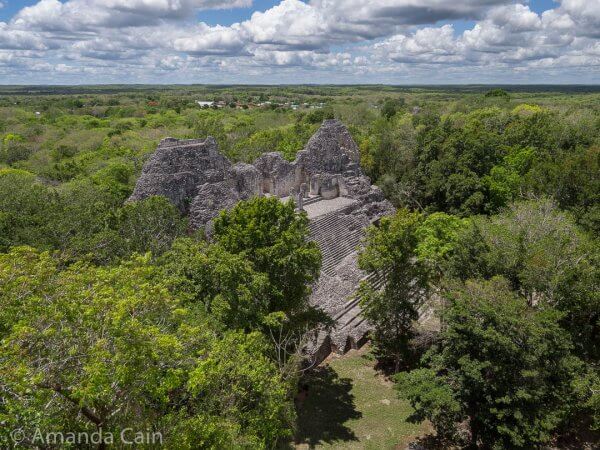
One of the palaces of Becan sticking up out of the jungle. Rio Bec Sites (Chicana, Xpujil, Hormiguero)
There are a lot of smaller sites in the area around the modern town of Xpujil (the main access to Calakmul, Becan & the Rio Bec sites), and it’s pretty easy to hire a taxi for the day to take you around them. And there are far more than we were able to visit.
Chicana
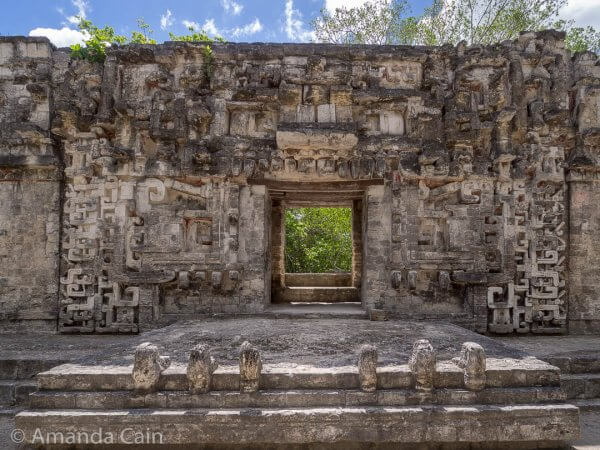
An entrance to a temple at Chicana. The decorations around the doorway are the mouth and head of a monster. (You can see the bottom teeth in the lower section of the photo at the top of the stairs.) By going inside the mouth of the monster, a priest was entering the Underworld.
Chicana has a lot of beautifully decorated buildings, and because it’s so close to Becan archaeologists think that it may have been where the upper classes from Becan lived. The building that stands out the most here is a building whose entrance is the mouth of a serpent. In Ancient Mayan beliefs it symbolised the entrance to the Underworld, so they think it may have been a temple.Xpujil
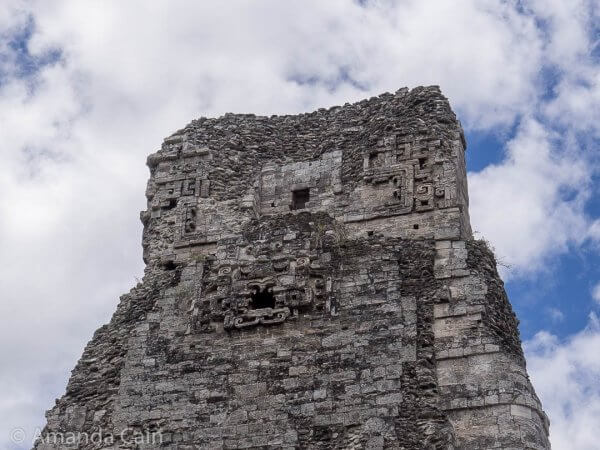
The back side of the central tower of Xpujil. You can see a jaguar face sticking out from the centre of it.
Xpujil is a pretty small site, but its main building is the temple with three tall towers. Only the centre tower is real. The two on the side have false stairs (almost vertical) leading to false temples (solid pile of stones), but it makes it look like you have three temples on top of three tall towers. There’s also a jaguar “mask” on the back side of the central tower.Hormiguero
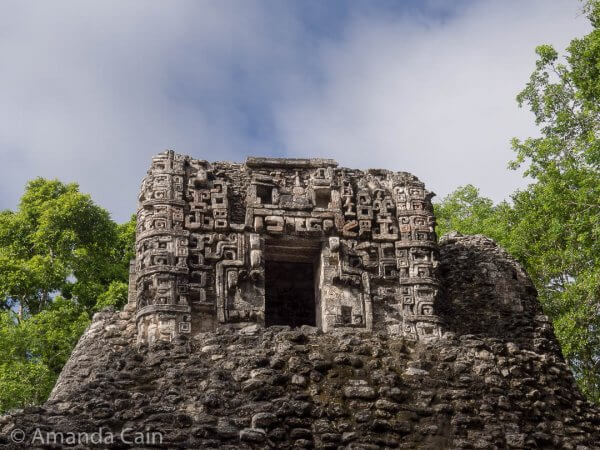
A highly decorated temple in Hormiguero. You can see a face above the door. The door is actually the mouth of the face, and it represents the portal to the underworld. You can also see smaller faces stacked along the side edges of the temple.
This site is being investigated, so there’s no information about what the buildings are. (But it’s also free to visit.) But the buildings are beautifully decorated and are impressive to see even without knowing anything about them.Palenque

The Temple of Inscriptions is the big pyramid on the left, and on the right is the temple with the tomb of the Red Queen.
To finish up we have Palenque, still one of our favourite ruins of Mexico. Sitting in the middle of the bright green jungle, with buildings partially overgrown with giant trees, makes it feel like that classic lost city in the jungle.
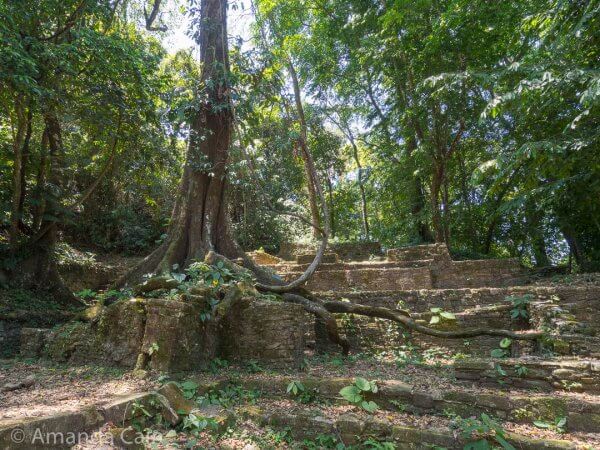
Archaeologists left some of the trees behind, still growing out of the ruins of Palenque. It’s things like this that make you think you’re in a movie or computer game.
One of the first big buildings you come across is the Temple of the Inscriptions, a large pyramid where the ruler Pakal the Great was buried. You can’t go inside anymore, but you can see a replica of the tomb, the actual carved stone sarcophagus, and replicas of the treasures he was buried with at the museum just outside the ruins.Palenque also has a large palace complex with a tall observation tower which they think was used for astronomical observations.

The observation tower of the palace. They think that it might have been used for astronomy.
There is also a plaza surrounded by three temple pyramids (Temples of the Cross Group), where you can climb up to the top and look inside the temples where intricately carved slabs of stone decorated the insides. (The originals are in the museum so you can get a good close look at them). But because the jungle is so thick, they’ve only uncovered the front sections of the two largest pyramids, leaving the sides and backs of them completely overgrown with jungle.

Quite a few temples surround this plaza, the big one on the right is the Temple of the Cross.
As you walk around the ruins you’ll find streams, waterfalls and pools running nearby smaller buildings that are still mostly covered by jungle. It’s a very cool and atmospheric site to wander around. And will definitely make you feel like some kind of explorer discovering lost cities.

Definitely looks like the entrance to a secret underground chamber full of treasure… Edzna
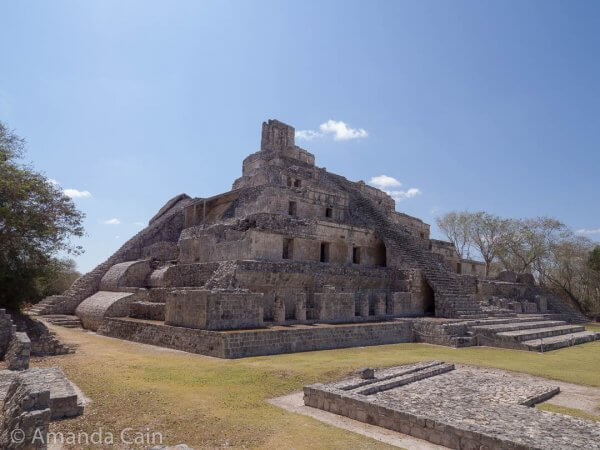
The impressive Temple of Five Levels in Edzna.
Edzna is a large site with a variety of buildings: pyramids, temples, ball courts, administration buildings and palaces. The most impressive area is the Great Acropolis with the large Temple of Five Levels towering over everything else. Archaeologists are still excavating it (they were even working on it when we were there), but the front and sides have mostly been preserved/restored.On one side of the building you can see curved sections, this is what they think all the sides looked like, with the curved bit being the roof of the rooms. Another thing that’s a bit different about it are the carved stairs leading to the top of the temple. So on the vertical parts of the stairs you can see Mayan glyphs carved into them. (This is also why you can’t climb up the temple.)
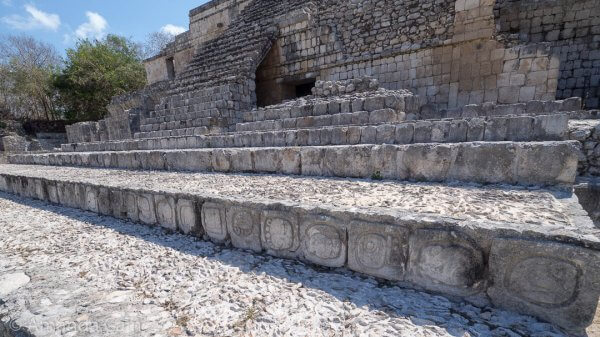
If you get up close to the Temple of Five Levels you can see that it has glyphs carved into the front of the stairs. Dzibilchaltun
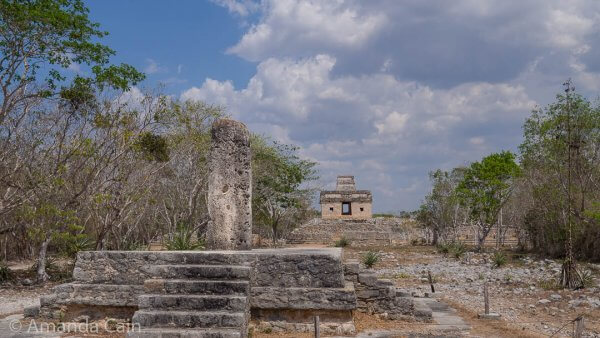
A stela (carved slab) on a platform, and the Temple of the Seven Dolls in the background. On the equinoxes you can see the sun rise through the door of the temple.
This is a relatively small site with a few restored buildings. Though we did spot an interesting looking building covered in trees and shrubs, but we couldn’t go in to look at it.There is one building, the Temple of Seven Dolls, that has doors opening on the front and back. During the equinoxes you can watch the sun rise or set through these doors. They have some impressive looking postcards there showing the effect. But probably the most popular feature is the pretty cenote (water-filled sinkhole) in the middle of the ruins. It’s nice and blue with water lillies, and very good for a refreshing swim after wandering around the ruins. (At the end of the dry season, when we went, it can get over 40°C regularly).
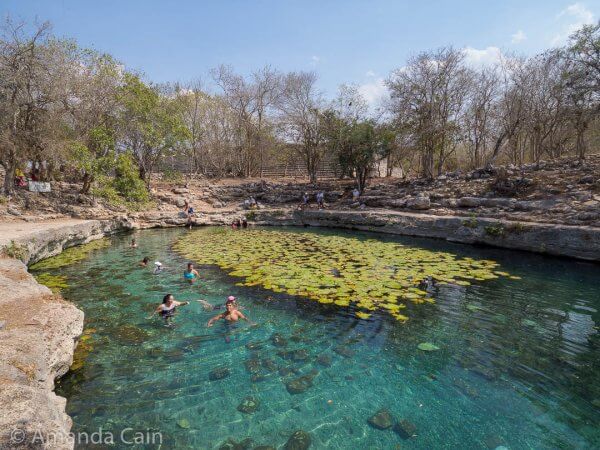
Dzibilchaltun has a nice refreshing cenote right in the centre of the ruins where you can cool off after a hot day wandering around the ruins. Wildlife
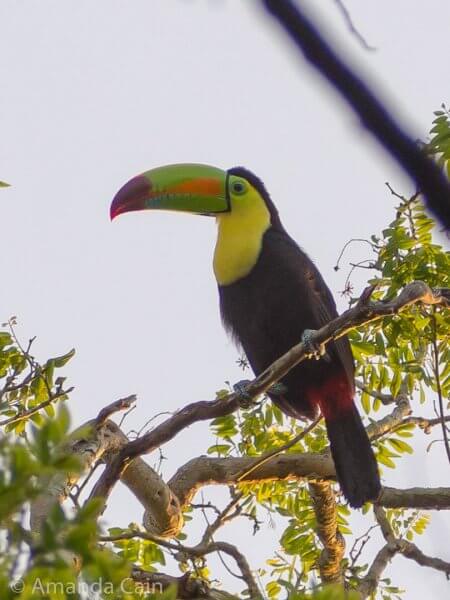
A very colourful toucan high up in the trees in Calakmul Biosphere Reserve.
And last but not least, the ruins are a great place to spot wildlife. We were surprised at how many different animals we saw at various ruins. At Palenque, Uxmal and Tulum you would see iguanas everywhere. And big ones too! Depending on what the environment is like around the ruins, you can also see monkeys, coatis and plenty of different kinds of birds. It seems like the ruins provide a nice sanctuary for the animals, which is why you can see so many. So keep your eyes out if you go visiting the ruins.
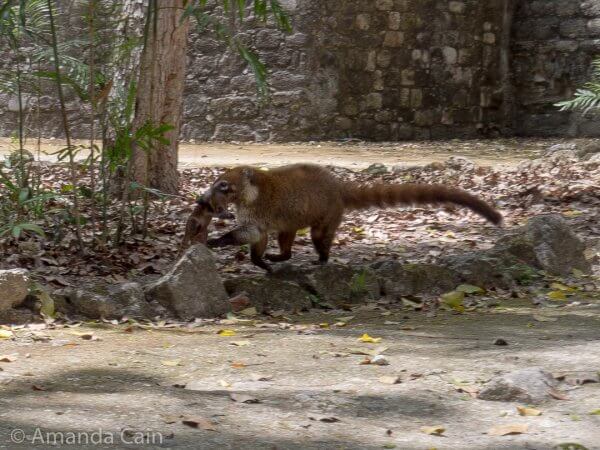
A mother coati carrying her baby in her mouth. The baby was probably about a week old, and too small to walk.
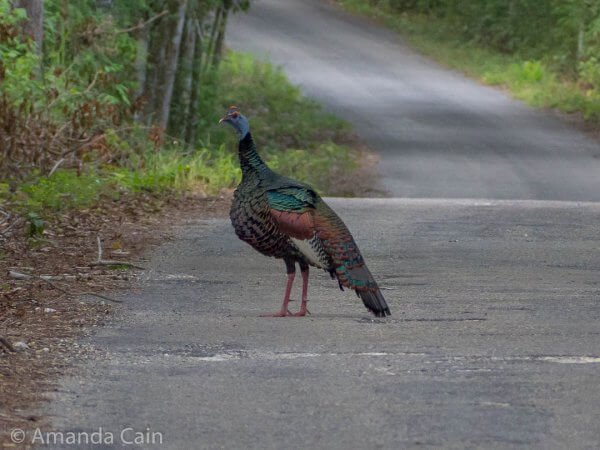
These colourful turkeys wander all over the road to Calakmul. This is because it’s a great place for the males to show off for all the females around.
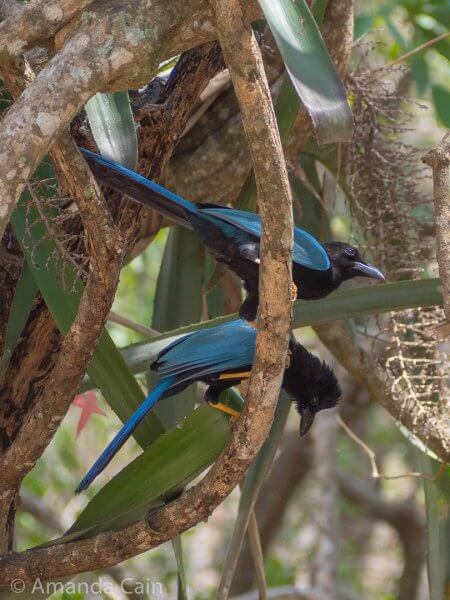
Yucatan jays hanging out around Edzna ruins.
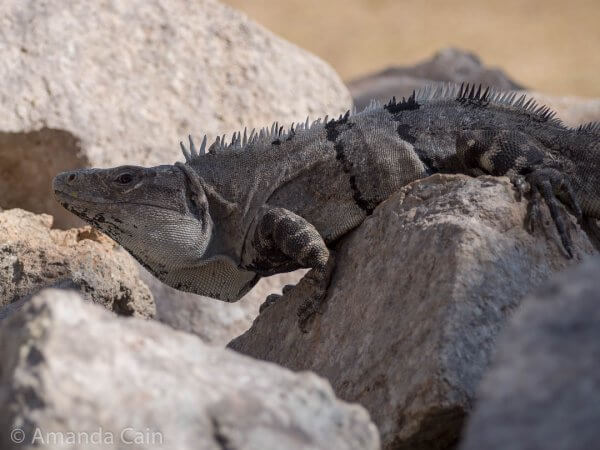
When you to see any Mayan ruins, you also see the countless iguanas that live inside them. This is one of the bigger ones.

Leave a Reply